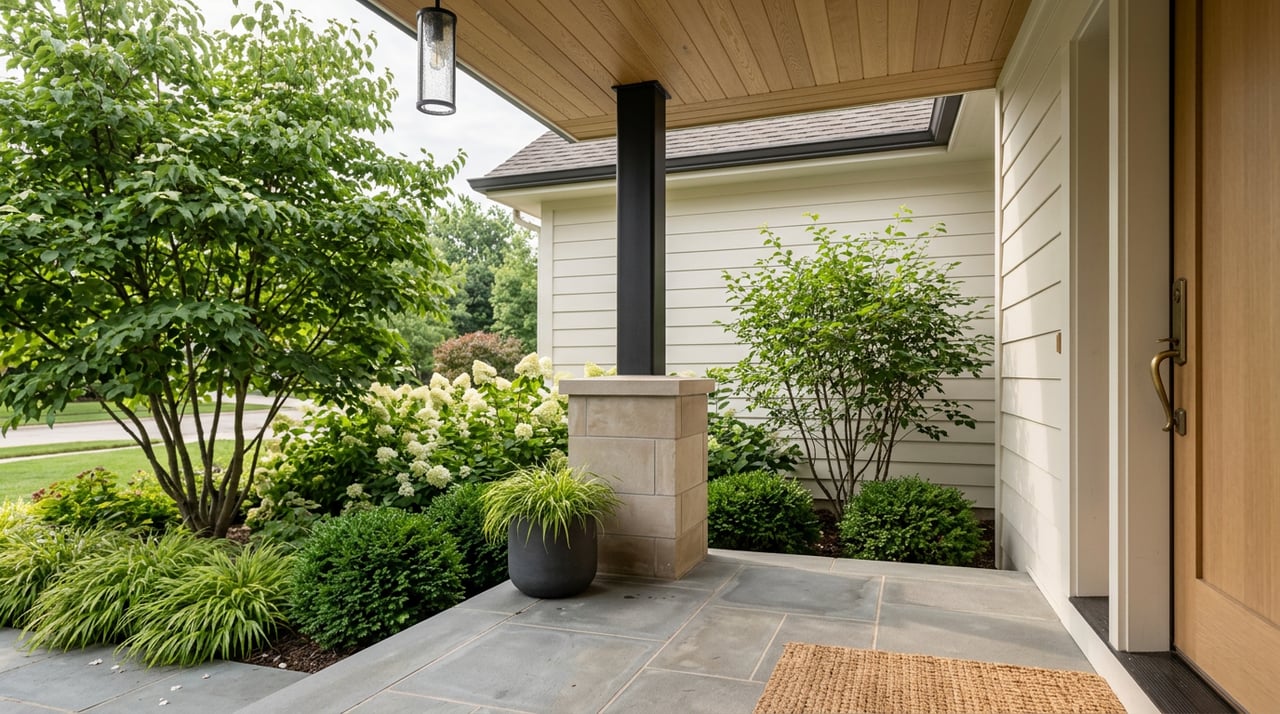
What $300,000 Actually Buys in Grand Rapids Right Now
The portals will tell you the median sale price in Grand Rapids sat at $300,000 over the three months ending May 2026, with homes going pending in about six days. That number is accurate. It is also misleading in a specific way that matters if you are shopping here this summer.
The median describes a market that no longer exists as a single market. It exists as three, stacked on top of each other, each with its own weather. Where you land inside that stack matters more than which neighborhood you pick.
Here is the piece most buyers miss. The typical new home being built across the Grand Rapids metro is not listing at the resale median. It is listing at roughly $444,000, with the range running from about $342,000 to nearly $1 million. Builders like Eastbrook Homes and JTB Homes are the most active in the ring around the city, and their communities in Caledonia, Byron Center, Hudsonville, and Rockford are pricing in the $414,000 to $511,000 band. A new Byron Center project starts at $342,000. A 27-lot single-family development in Walker starts near $400,000.
Almost nothing new is being delivered below $250,000. That fact drives everything else.
When new construction only lands at core-to-luxury prices, every buyer priced under $250,000 competes exclusively for existing homes. And existing homes below that price band are the tightest part of the market. Local reads from May 2026 put the pending-to-active ratio in the scarcest band around 179 percent, meaning almost twice as many homes are under contract as are actively listed. The band that includes the metro median around $300,000 is running near 149 percent. Only above the top tier does the ratio finally slip under 100 percent, closer to 86, which is where buyers get room to negotiate.
That is the thesis. Your competition is not defined by the neighborhood you love. It is defined by the price band you can reach.
| Price band | What's happening | Pending-to-active |
|---|---|---|
| Under ~$250,000 | Starved of new supply, bidding pressure lives here | ~179% |
| ~$250K to ~$400K | Highest volume band in West Michigan, move-in-ready homes go in about 21 days in Forest Hills, Hudsonville, Zeeland | ~149% |
| Above the top tier | More active listings than pending deals, room to negotiate on anything that has sat 30 days | ~86% |
The per-square-foot appreciation number tells the story more cleanly than the headline median. Redfin's city read pegs median price per square foot at $215, up 4.9 percent year over year through May 2026. Per-foot moves less than the headline because it strips out the mix of homes that happened to sell in a given month. That steadier signal is what you should watch if you are deciding whether to buy now or wait.
Rates make the picture less dramatic than it feels. Freddie Mac's week ending May 28, 2026 put the 30-year fixed at 6.53 percent, down from 6.89 a year earlier. On a $350,000 loan, that shift trims roughly $80 a month. Real, but not the reset some buyers are still parked on the sidelines waiting for.
The same check buys three genuinely different lives depending on which corner of the city you look in. This is where the neighborhood decision reenters the equation.
Creston. The city's largest neighborhood, once quiet and now on more radars. $300,000 in Creston tends to buy a mid-century single-family with a yard, walkable access to the Plainfield Avenue business strip, and a short bike to Riverside Park along the Grand River. Expect competition. The value story is out and the lower price brackets here are the tightest part of the neighborhood.
Eastown. Prices run roughly $250,000 to $450,000 across the Wealthy Street corridor. Your $300,000 leans toward the smaller end of the housing stock, often a bungalow needing selective updates. What you are paying for is walkability the rest of Grand Rapids cannot replicate: coffee, restaurants, and a short commute to downtown employment. Buyers who put a dollar value on not driving find this trade obvious.
Heritage Hill. Prices span $250,000 for smaller homes needing work up to $750,000 or more for restored large estates. At $300,000 you are shopping the entry end of a National Historic District. That means Victorian and Queen Anne architecture, character in every room, and a maintenance budget that reflects the age of the housing. Buyers here are trading modern floor plans for a home that will not resemble anyone else's.
Comstock Park. Median hovers around $307,000. $300,000 here buys more square footage and a more efficient commute up US-131, at the cost of the walkability the urban neighborhoods offer. This is the practical choice for buyers who want an efficient entry point to the metro.
Wyoming. Around $287,000 median. $300,000 stretches into slightly newer housing stock or a larger lot. This is the lowest-priced major submarket in the metro and the closest thing to breathing room for a buyer capped near the median.
East Grand Rapids. Listed here only as a ceiling reference. Redfin reported a $738,000 median in January 2026, up 34 percent year over year. $300,000 is not a shopping band in this submarket, and pretending otherwise wastes tours.
The above-list intensity has softened. In 2025 roughly half the city sold over asking. That share has cooled into the mid-20s in recent months, and the count of listings taking price reductions has climbed. Sale-to-list ratio still holds near 98 percent through spring 2026, which is close enough to list price that sellers are not folding, but the number of offers per home has thinned enough that inspection and financing contingencies are back in play on many deals.
Two practical implications follow.
First, if your budget puts you in the under-$300,000 band, expect the market to feel like 2022. Fast, competitive, and mostly resale, because the builders are not competing with you. Your edge is preparation. Full underwriting from more than one lender, a clean offer, and a decision timeline measured in hours rather than days.
Second, if your budget stretches to $400,000 or above, the market feels different. Anything that has sat 30 days is negotiable. Sharp pricing and clean condition still win, but the era of naming any price and collecting 15 offers over ask is over. Buyers in this band can afford to inspect properly, ask for repairs, and walk away.
The Seidman Business Review's 2025 recap put local home price growth at 6 percent for the year, following 7 percent the year before, with inventory sitting at a 1.4-month supply. Consensus rate forecasts now cluster in the low-to-mid 6s for most of 2026. That combination continues the pattern the last two years have set: prices grind higher at a moderate pace, inventory stays scarce enough that well-priced homes move fast, and negotiation power lives at the top of the price stack rather than the bottom.
The Chicago-to-Grand Rapids relocation pipeline is still feeding demand, and the regional employer base of Corewell, Steelcase, Amway, Meijer, Perrigo, MillerKnoll, BDO, and Trinity Health keeps that flow steady. The Acrisure Amphitheater opened this spring along the Grand River, and downtown foot traffic is expected to run heavier through summer nights than any recent year. None of that changes the mechanism. It reinforces it.
If the median is $300,000 and rates dropped, why does my search feel harder than my friend's did a year ago? Because the softening happened in the top of the market. Below the median, pending-to-active ratios stayed tight and new construction did not fill in behind you. Your friend was almost certainly shopping in a different band.
Should I keep waiting for rates to drop before making an offer? The Freddie Mac 30-year averaged 6.53 percent the week ending May 28, 2026, and had ticked up from 2026 lows near 6.36 mid-month. A meaningful move below 6 is not the base case in any current forecast. Waiting has a real cost when local per-square-foot values are still up almost 5 percent year over year.
Is there any part of the metro where a buyer at the median has real leverage? Leverage is a function of price band, not geography. Above the top tier the pending-to-active ratio slips under 100 percent, and homes sitting past 30 days on market invite price and repair negotiation. At the median, leverage comes from being the cleanest offer rather than the highest.
If you want to see what your specific number buys across the neighborhoods that actually fit your life, the team at Bialik Real Estate can map your price band to the corners of Grand Rapids where it goes furthest, and where the competition is thinnest. Start Your Property Search when you are ready.
Working with Bialik Real Estate means more than just buying or selling a home—it means experiencing a higher level of service.